Brain Hack Notes
Our pitch
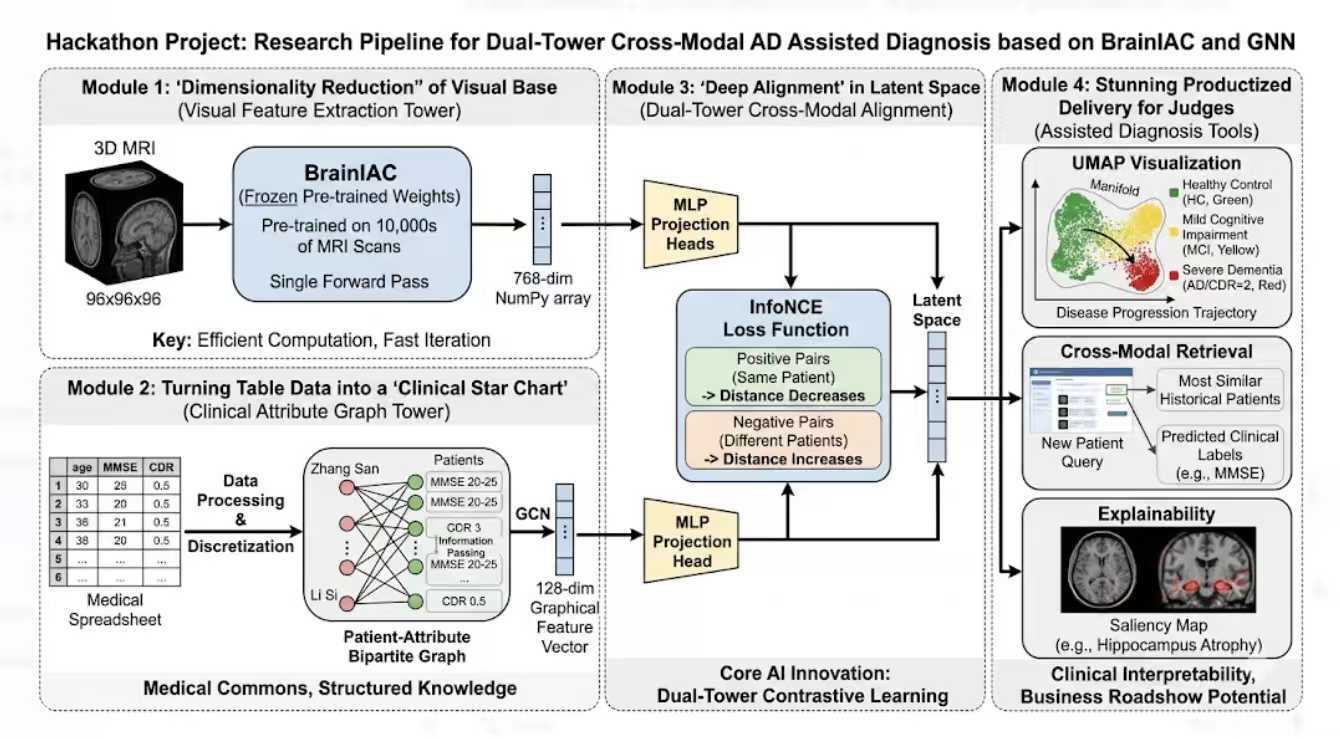
Traditional neuroimaging analyses focus on visual features, which makes it difficult to portrait continuous clinicopathological changes. To facilitate the synergetic analyses of similar records, we attempt to use constrative learning, a cutting edge self-supervised deep learning framework, to map the individual MRI features into a high-dimensional manifold with reference to the topology correlations in their pathology records. Specifically, it requires a specialized similarity metric incooperating both imaginery and graphical informations. The expected outcome is an interactive web interface tool to visualize the disease’s evolutionary trajectory and pinpoint pathogenic brain regions.
A interactively demo of the MRI extracted representatives vectors are shown in the link below using Three.js
Ref: {UMAP explained} {BrainIAC – Nature} {My Note of WesternBrainHack2026}
Dataset: {Oasis}
fNIR: Functional near-infrared spectroscopy
Low cost portable brain mapping. Measure Infrared source-sensor pairs correlations to inverse oxygen concentration and blood flow (hemodynamics) as a approximation of functional MRI. fMRI (functional magnetic resonance imaging) also measure blood oxygen (mainly in the gray matter) while the diffusion MRI (a.k.a., DTI diffusion tensor imaging) portraits in white matter (water pathway).
 fMRI detect active regions in gray matter. |  dMRI highlight white matter pathways |
Ref: https://mayfieldclinic.com/pe-fmri_dti.htm
Pros & Cons:
Pros: cheaper and more portable than fMRI. Non-invasive.
Cons: Variability across different data processing pipelines.
More details in this nature neurophotonics review paper {Link}
Main use case from the speakers is long-term monitoring for inaccessible patients and short-term neural responses.
Subcortical anatonmy
Deep brain stimulation (DBS): classical model has iMSG and dMSG control excitation and surpression. think the indirect message surpress the direct message disrupting the action (motor cortex). DBS insert an electrode to supress indirect message. Use MRI to locate the target region. current interst (zona incerta: uncertain zone). When STN too active, brake too strong, no movement, STN too inertia, parkinson, brake too weak, Huntington Dancing.
Thalamus (丘脑) relay station, STN (subthalamic nucleus) , DBS put a electrode near thalamus. 1.5T regular MRI is not precise enough, they use multi-modal high intensity 7Tesla MRI (Multi-modal here implies T1, T2, R1map scanning resulted MRI images that can jointly help identify certain regions, e.g., zona incerta need R1map).
RSA tool box
https://rsatoolbox.readthedocs.io/en/stable/
Finger operations in a small cortex region. {Link-Nature Neuroscience}. Seems just correlation analysis of cortex and joint activation.
prewhiten – mahalanobis metrics how these two correlated?
Their paper: {Link-PDF}
Hippounfold
In {Remanian Geometry-Wiki}, Laplace-Beltrami operator imposed a potential field operator \(g_{ij}\) on the coordinates. A direct effect of this is the minimal distance is not L2-norm but some x,y weighted-norm. This g can be a function of (x,y), e.g., in parabolic geometry, \(g(x,y)=1/y^2\). In computer graphics, it may be better known as Lapcian surface editing {ArXiv-Paper}.
P.S., in neuroscience, registration, e.g., for images, sensors, implies aligning them to the same coordinate system.
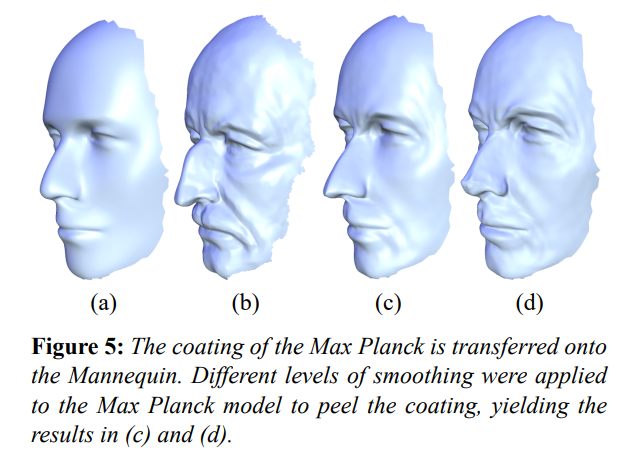
Ref: https://igl.ethz.ch/projects/Laplacian-mesh-processing/Laplacian-mesh-editing/laplacian-mesh-editing.pdf
MonAI for neuroimaging
Two kaggle projects for {detection} and {segmentation}. The monai provides tens of models for quick deploy and fine tuning.
3D printing brain
Motivation: prototyping with low cost
Types of 3D printing:
- Fused Deposition Modeing (FDM) melt the material (PLA).
- Stereolithography (SLA): laser solidifies resins
- Selective laser sintering (SLS): meltingDesign
Process of 3D printing. Design: thingiverse.com repository and use Solidworks, Shapr3D, TinkerCAD
Brain printing:
- get anatomic.nii from T1 MRI
- use FreeSurfer to obtain cortex surfaces and atlas mapping etc.

Snakemake for data management
Pixi for quick workflow transfer.
Snakemake starting tutorial {git_repo}