Remote Sensing techniques
Inspired by Guo’s work. Notes of related techniques.
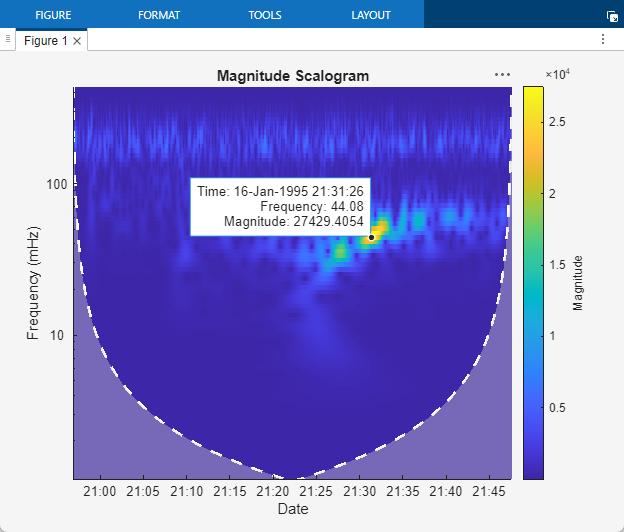
COI in CWT
Cone of interest in Continuous wavelet transform.
CWT stretch (a) and translate (b) the mother wavelet that has finite length. At the edge of the waveform, the transformed wavelet exceeds the boundary, known as edge effect. Thus, scalograms need a Cone of Interest (COI) to remove the artifact.
An intuitive explaination is that at the edge, b=0, nearly all daughter wavelet exceeds the boundary, but near the center, only thos highly stretched wavelet (large a) tend to exceed the boundary.
One way to compute COI is e-fold power decay, where amplitude of the autocorrelation of the wavelet < 1/e.

Archetypical Analysis
AA find the archetypes that best represents the extremes of the dataset. AA is an unsupervised learning that can be expressed by
, a convex optimization target that all data samples are approximated by convex combinations B of prototypes Z
It is described by three equations
, which implies the prototype space Z is also a convex span of data samples X.
Compared to other methods:
KNN means the kernel (mean) of each cluster. PCA identify largest variance; AA focus on the boundary prototypes, more sensitive to extreme values (a boon and a bane).
Ref: Github repo for coding implementation {Link}; original AA report {UofUtach&UofCal}, quick math notes {ArXiv}
NDVI
Normalized Difference Vegetation Index (NDVI) captures the key physics that leaves absorb red light but reflect near infrared thus, NDVI. {Skarlatos, 2018} adapt the scheme for drone digital surface reconstruction. {Chen 2024} still propse new vegetation index purely based on RGB images.